
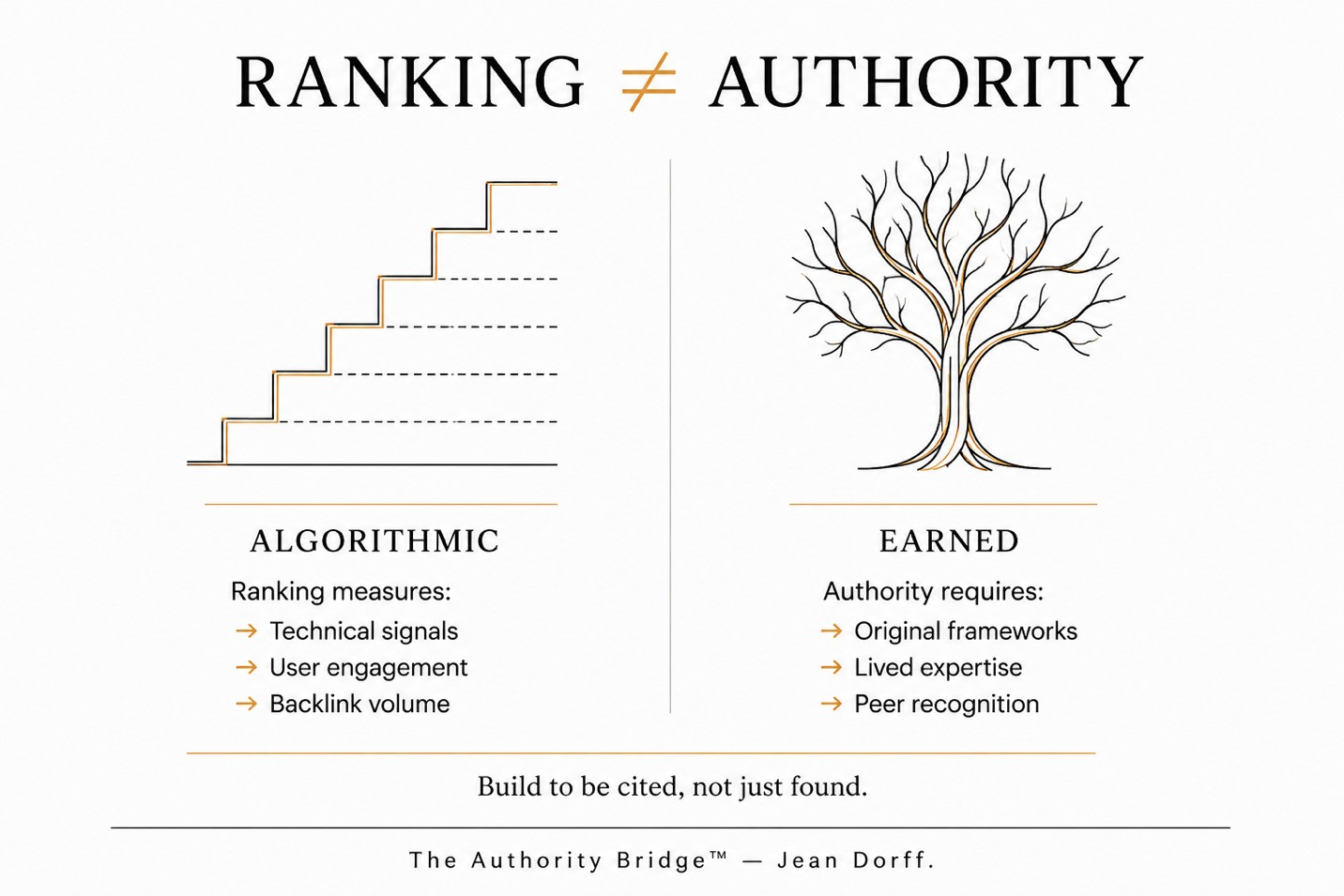
Most professionals assume visibility leads to authority. It doesn't. Search rankings measure discoverability — technical signals, backlinks, content volume. Authority measures contribution — original frameworks, documented methodologies, recognition earned over time. This article examines why the two operate on entirely different logic, why expertise stays invisible without structure, and what it actually takes to become the kind of source others cite rather than simply find.
TL;DR
High Google rankings don't equal genuine authority. Rankings reflect algorithmic signals (technical SEO, backlinks, content volume). Authority reflects demonstrated expertise, original frameworks, and sustained contribution. In the AI search era, identifiable experts with documented methodologies get cited. Anonymous content farms get ignored. Build authority first, then use SEO to amplify.
Core distinction: Search visibility rewards discoverability. Authority earns recognition. They're independent variables.
Who this is for: Subject matter experts with deep knowledge watching thinner content outrank them.
Quick Answer
Rankings ≠ Authority: High rankings come from technical SEO, backlinks, and content volume. Authority comes from original frameworks, proprietary methodologies, and peer recognition.
E-E-A-T matters: Google evaluates Experience, Expertise, Authoritativeness, and Trustworthiness. These are quality signals, not direct ranking factors.
AI search changes everything: AI systems (Google AI Overviews, Perplexity, Bing Copilot) cite sources, not rank them. They prioritize identifiable experts over anonymous content.
Build authority first: Codify expertise into frameworks, publish original insights, and optimize for being cited rather than found.
The Problem: Why Expertise Stays Invisible
You search for advice on enterprise architecture. The first result is a content aggregator publishing 47 articles last week across unrelated topics. The second is a consulting firm website optimized for every keyword variation of "digital transformation." The third is an affiliate site recommending software platforms the author never implemented. Somewhere on page three sits a practitioner who spent 30 years developing a methodology for aligning technical systems with organizational strategy.
This is the internet's authority problem. The websites ranking highest aren't always the ones knowing the most. They're the ones understanding the game.
Search visibility and genuine authority operate on different systems. One rewards discoverability through algorithmic optimization. The other earns recognition through demonstrated expertise.
Key Point: High search rankings reflect algorithmic signals (technical SEO, backlinks, content volume). Genuine authority reflects demonstrated expertise, original frameworks, and industry recognition. These sometimes overlap, but they're independent variables.
What Is an "Authority Website"?
An authority website is a domain that earns recognition through demonstrated expertise, original contributions, and industry trust. The term originated in SEO communities in the mid-2000s to describe sites that ranked consistently and recovered quickly from algorithm changes. True authority comes from intellectual contribution, not algorithmic optimization.
The phrase "authority website" entered the common language through SEO circles in the mid-2000s. It described sites Google appeared to trust more. These sites ranked faster, held positions longer, and recovered quickly from algorithm changes. The assumption was simple: if Google trusted the site, the site must be authoritative. This confused cause and effect.
Google didn't trust these sites because they were authoritative. Google trusted them because they demonstrated algorithmic signals: backlinks from credible domains, consistent publishing, topical depth, user engagement, and technical stability.
E-A-T vs. E-E-A-T: The Evolution
When Google introduced E-A-T (Expertise, Authoritativeness, Trustworthiness) in its Search Quality Rater Guidelines in 2014, many believed it was a ranking factor you could optimize for directly. It wasn't. E-A-T was a quality framework used by human raters to train the algorithm. The framework described what Google's systems were designed to reward, not a checklist you could complete.
In late 2022, Google added "Experience" to the framework, creating E-E-A-T. This update signaled that firsthand involvement matters as much as credentials. Content demonstrating product use, visiting a location, or communicating lived experience now carries weight alongside expertise.
Key Point: E-E-A-T (Experience, Expertise, Authoritativeness, Trustworthiness) is a quality signal, not a ranking lever. A site ranks well without satisfying E-E-A-T deeply. A practitioner satisfies E-E-A-T without ranking at all.
What Makes a Website Rank Highly?
Search rankings follow mechanical rules. You rank without being an authority because ranking measures different things than authority does.
1. Search Intent Alignment. Google evaluates search intent first. If someone searches "best running shoes for flat feet," Google prioritizes pages matching the specific intent. A generalist sports blog with strong SEO outranks a podiatrist's detailed biomechanical analysis if the blog's page better matches searcher intent. Relevance to the query matters more than depth of expertise.
2. Technical SEO Foundations. Page speed, mobile responsiveness, clean code, structured data markup, and crawlability create the technical foundation. A site loading slowly or breaking on mobile won't rank well, regardless of the expertise inside. The algorithm rewards sites functioning smoothly. Technical competence and intellectual competence are separate problems.
3. User Engagement Signals. If people click your result, stay on the page, and don't immediately return to search, Google interprets this as satisfaction. A site wins on engagement without offering deeper insight. If the page answers the question quickly and clearly, users leave satisfied. The algorithm doesn't measure whether they learned something transformative or got a quick answer.
4. Backlink Profile. Backlinks remain one of the strongest ranking signals. When credible sites link to your content, Google interprets this as endorsement. Backlinks measure popularity and network reach, not expertise. A viral listicle accumulates more backlinks than a rigorous research paper. The algorithm doesn't distinguish between links earned through genuine insight and links earned through shareability.
5. Domain Strength and Age. Older domains with consistent publishing, clean link profiles, and steady traffic carry built-in advantages. A new expert entering a field faces structural disadvantages regardless of their knowledge depth. The algorithm favors established presence. The most knowledgeable person in a room often ranks behind the most established website in the niche.
6. Topical Coverage and Content Depth. Google evaluates whether your site comprehensively covers a subject area. Publishing regularly across related topics signals topical authority. Coverage and insight aren't identical. You publish 100 articles on a topic without contributing a single original idea. Volume of coverage and depth of contribution are different measures.
Key Point: Search rankings get determined by intent alignment, technical performance, engagement signals, backlinks, domain strength, and topical coverage. None of these requires genuine expertise. They require understanding what the algorithm values and delivering consistently.
Comparison: Rankings vs. Authority
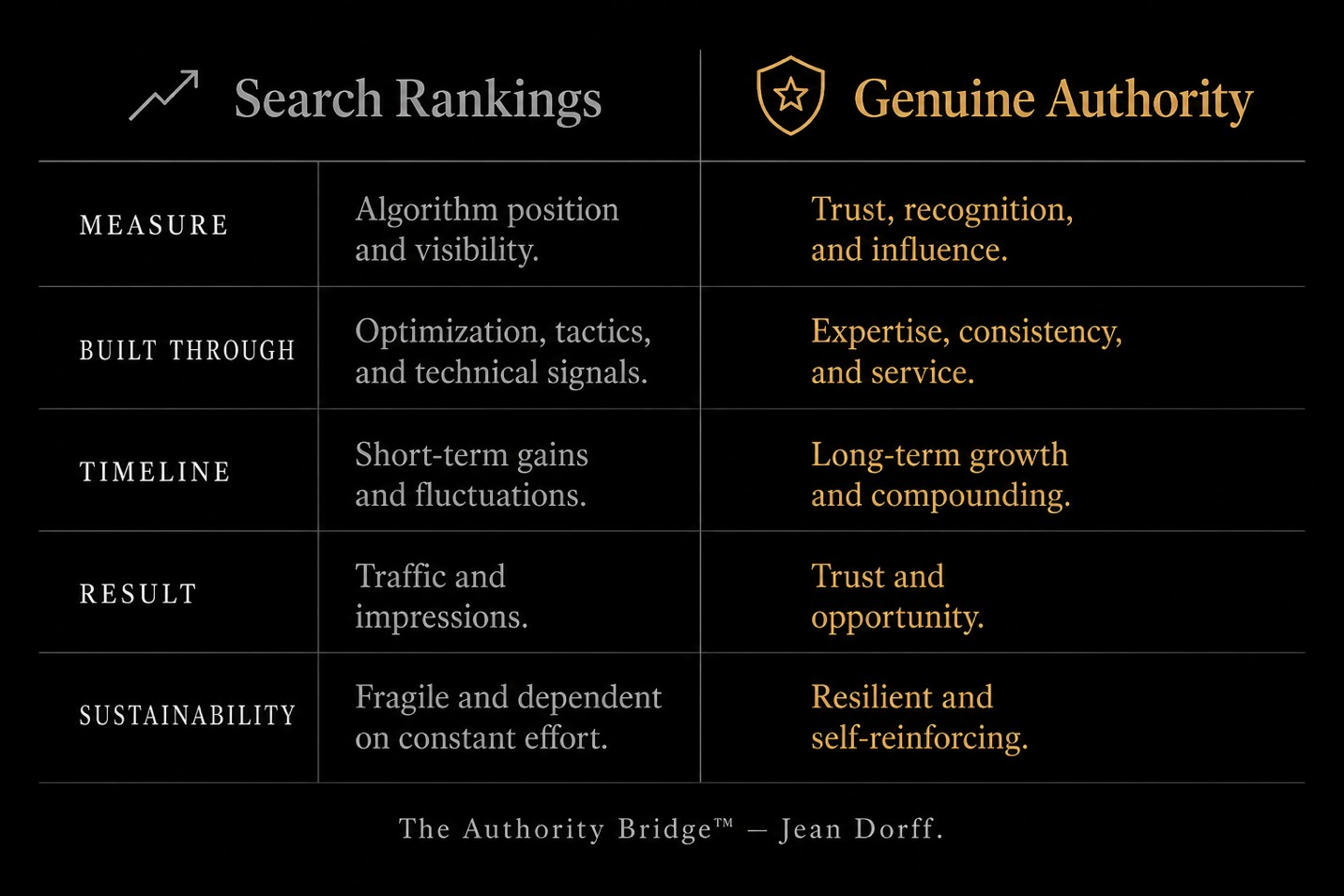
Search Rankings — Measure: Discoverability. Built through: Technical SEO, backlinks, content volume, engagement signals. Timeline: Months to achieve with consistent optimization. Result: You get found when people search. Sustainability: Vulnerable to algorithm changes.
Genuine Authority — Measure: Recognition and contribution. Built through: Original frameworks, proprietary methodologies, peer endorsement. Timeline: Years of sustained contribution. Result: You get cited as a primary source. Sustainability: Compounds over time, outlasts algorithms.
Why Websites Rank Highly Without Being Authorities
Sites win rankings through means other than genuine expertise because ranking measures discoverability, not depth.
Aggregator sites rank because they publish volume across every angle of a topic, optimize for every keyword variation, and update constantly. They win on breadth and freshness. Aggregation isn't synthesis. Collecting information from multiple sources and repackaging doesn't create new knowledge. It creates convenient access to existing knowledge.
AI-generated content farms exploit the same pattern at scale. They produce hundreds of articles optimized for search intent and user engagement signals. Early rankings come quickly. Sites winning through volume rather than insight face diminishing returns as algorithms evolve to detect thin content patterns and audiences learn to recognize the absence of genuine perspective.
Affiliate websites rank by matching commercial intent precisely. Someone searching "best project management software" wants recommendations, not theory. An affiliate site with clean comparison tables and user reviews satisfies the intent efficiently. The site doesn't need to understand project management deeply. It needs to match what the searcher wants in the specific moment.
News sites cover topics outside their expertise because they carry domain authority built across decades of publishing. A major publication ranks for "accounting automation strategies" even though its business reporter spent two hours researching the topic. The domain's overall strength carries the article. The algorithm trusts the site, even when the specific content lacks depth.
Sites winning through volume demonstrate that consistent publishing creates compounding ranking advantages. A site publishing three articles per week for five years has structural advantages over a practitioner publishing one deeply researched piece per month. The algorithm rewards consistency. Authority rewards depth. These incentives pull in opposite directions.
The internet is full of websites that rank well because they answer questions. Very few rank because they change how people think.
Key Point: Aggregators, AI content farms, affiliate sites, and high-volume publishers all achieve strong rankings without genuine expertise. Ranking measures discoverability, not depth, originality, or the ability to influence how a field thinks.
What Defines Genuine Authority?
Genuine authority is recognition earned through original frameworks, proprietary methodologies, published research, sustained contribution, and peer endorsement. Authority influences how people think about problems, not just how they solve them. Search engines measure discoverability. Authority measures contribution.
Authority comes from contribution, not visibility. The markers of genuine authority are invisible to search algorithms but immediately recognizable to people needing expert guidance.
Original frameworks signal authority in ways you can't manufacture. When you develop a methodology others adopt, reference, and build upon, you've created intellectual infrastructure. An authority in organizational design, for example, might reframe change management not around communication plans or stakeholder buy-in, but around the collapse of decision-making clarity when reporting structures shift. This reframe doesn't emerge from reading case studies. It emerges from decades of direct work with leadership teams, from noticing what every existing approach consistently misses.
Proprietary methodologies distinguish experts from educators. Anyone teaches existing knowledge. Developing new approaches to persistent problems requires sustained engagement, producing insights unavailable through study alone. Original methodologies are born from gaps between theory and lived experience.
Published research and documented outcomes establish credibility in ways content marketing can't replicate. A bestselling book establishes authority in a field. The discipline of translating complex thinking into structured, publishable form, sustained across multiple works over time, is itself a form of authority that volume-based content production can't replicate.
Cross-domain experience producing pattern recognition. Google's E-E-A-T framework rewards the "Experience" dimension because firsthand involvement creates a different quality of knowledge. Working across disconnected fields produces a form of pattern recognition single-domain expertise rarely generates. Seeing the same problem repeat in entirely different contexts allows someone to identify the structural cause rather than the situational symptoms.
Industry recognition comes from peers, not algorithms. When other experts cite your work, adopt your frameworks, or reference your methodologies in their own practice, this signals authority. These endorsements happen slowly. They compound over time. They can't be manufactured through SEO tactics or content calendars.
The ability to influence thinking separates authorities from educators. When your work changes how people understand a problem, not how they solve it, you've moved beyond information transfer into genuine thought leadership. Naming a structural problem most practitioners have felt but never had language for is the clearest marker of authority.
Key Point: Genuine authority gets built through original frameworks, proprietary methodologies, cross-domain experience, published contributions, peer recognition, and the ability to change how a field thinks. These get earned through sustained contribution over time, not optimized for.
The Real Problem Isn't Expertise: It's the Codification Gap
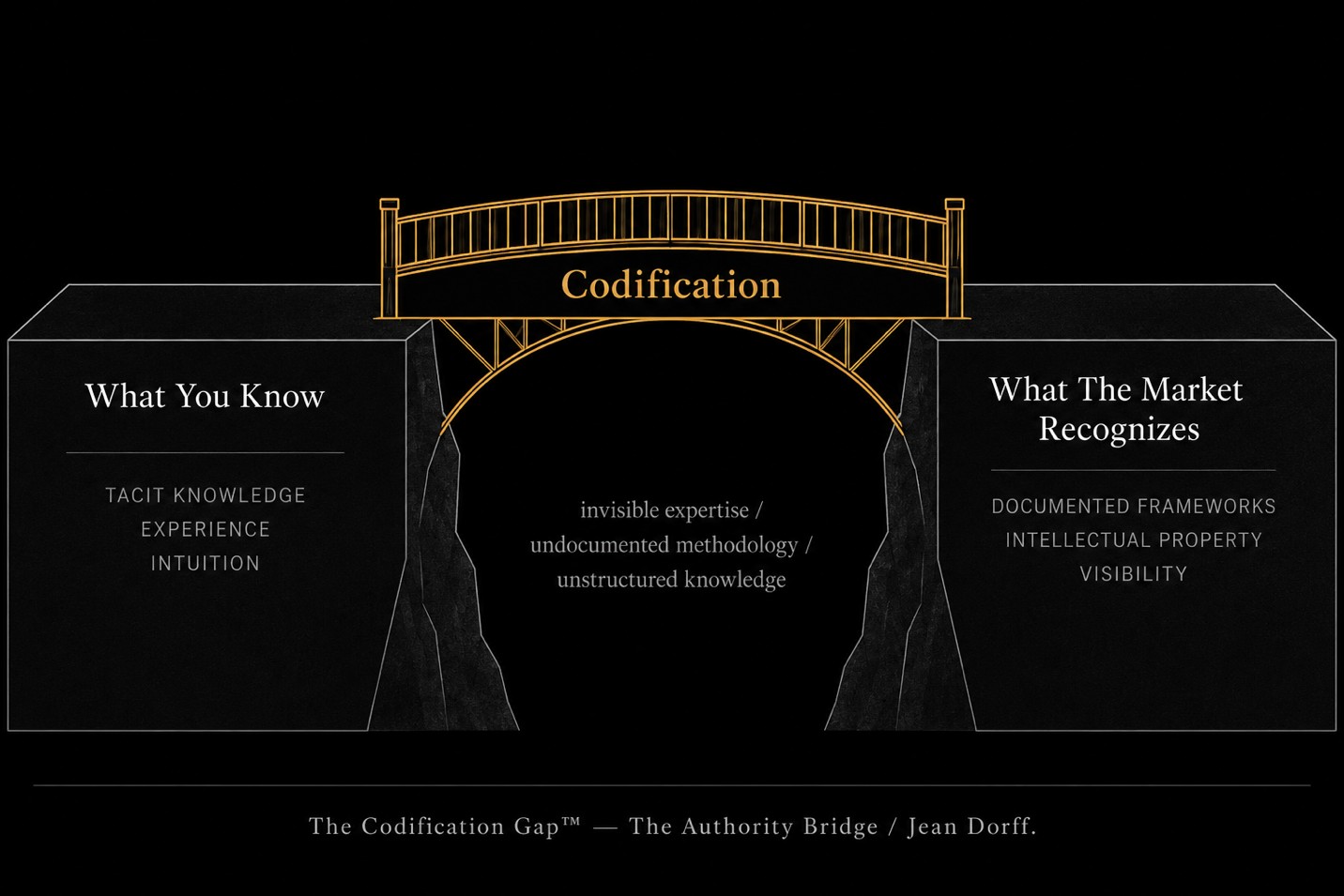
Most professionals seeking market recognition don't suffer from an expertise problem. They suffer from the Codification Gap. The Codification Gap is the distance between what you know and what the market recognizes you know. Your expertise exists. It lives in decades of client conversations, in pattern recognition you apply instinctively, in frameworks you use without naming them, in decisions you make based on experience you've never documented. This knowledge is real. But it's invisible.
It lives in your head, not in the world. You know why certain approaches fail before trying them. You spot the structural problem underneath the surface symptoms. You see patterns across client situations others miss. But these insights remain tacit. They're available to the people working directly with you. They're unavailable to everyone else.
It lacks transferable structure. If someone reads your content, attends your workshop, or studies your approach, they walk away with information, not a system. They understand what you think. They don't understand how you think. Without structure, expertise stays tied to you. It doesn't scale, compound, or become something others build upon.
It can't be cited, only experienced. Your clients know you're exceptional. Your colleagues respect your depth. But when someone searches for solutions in your domain, your name doesn't appear. When an AI system synthesizes expert perspectives, your frameworks aren't referenced. The market doesn't doubt your expertise. The market can't find it.
Codification isn't content creation. It's knowledge architecture. Writing blog posts doesn't codify expertise. Publishing LinkedIn updates doesn't codify expertise. These activities share insights. They don't structure them into transferable intellectual property. Codification means taking the pattern you've observed across hundreds of client engagements and building it into a named framework.
You don't lack expertise. You lack the structure making expertise visible.
Key Point: The Codification Gap is the distance between expert practitioners and recognized authorities. Expertise without structure remains invisible, non-transferable, and impossible to cite. Building authority starts with closing this gap by transforming what you know into intellectual property the world recognizes, references, and builds upon.
Does Authority Exist Without Strong Rankings?
Yes. Authority and rankings are independent variables. Many of the most respected practitioners have minimal search presence.
Niche experts often rank poorly because their work serves small, specialized audiences. The work is too specific, the language too precise, the audience too narrow for broad SEO visibility. Within the niche, the expert's authority is unquestioned by those who matter most.
Academic researchers prioritize peer recognition over public visibility. Their authority comes from publications, citations, conference presentations, and institutional affiliation. Search engines largely miss them, yet their influence on their field is profound and lasting.
Industry specialists build authority through client results and professional networks. Referrals and reputation drive their business. They're harder to find through search, but impossible to ignore once you encounter their work. These professionals are no less authoritative because they rank poorly. They're less discoverable. Discoverability gets improved. Authority must be earned.
Key Point: Authority and rankings are independent. Many of the most respected practitioners in any field have minimal search presence. Discoverability is a strategic choice. Authority is a long-term outcome of consistent, original contribution.
Why the Visibility-Authority Distinction Matters in the AI Era
AI-generated content and AI-powered search make the visibility-authority distinction more consequential than at any previous point in internet history.
AI summarizes information. It doesn't create lived expertise. Large language models excel at synthesizing existing knowledge. They don't develop original frameworks from decades of cross-domain practice. The knowledge emerging from sustained engagement with real, complex human problems across multiple contexts isn't available in any training dataset.
Search is shifting from information retrieval to expertise validation. When AI generates adequate answers to most questions instantly, the value of search shifts to sources offering something AI doesn't replicate: original thinking, proprietary methodologies, and insights born from sustained engagement with complex, real-world problems. The question searchers are increasingly asking isn't "what is the answer" but "who do I trust to guide me."
AI search systems cite sources, not rank them. Generative AI features in search (Google's AI Overviews, Bing Copilot, Perplexity) synthesize information and attribute it to sources. Getting cited by an AI system requires clear, structured, authoritative content demonstrating genuine expertise. Identifiable experts with documented methodologies and original frameworks are more likely to get referenced as primary sources.
The future belongs to identifiable experts, not anonymous content. As AI-generated text floods the internet, the signal mattering most is verifiable human experience. Who created this framework? What's their background? How long have they worked in this field? What have they built others now use?
Structured data and author markup become authority signals. Schema markup for authors, article schema with clear authorship, and FAQ schema positioning your answers as definitive all help AI systems identify and cite your content correctly. Technical optimization for AI search isn't about keywords. It's about making your expertise legible to systems evaluating source credibility.
Key Point: In an AI-driven search environment, the competitive advantage shifts toward identifiable experts with original frameworks and documented methodologies. AI generates content. It doesn't generate lived expertise. The professionals who built intellectual capital get cited, not just found.
How to Build Authority (Not Just Visibility)
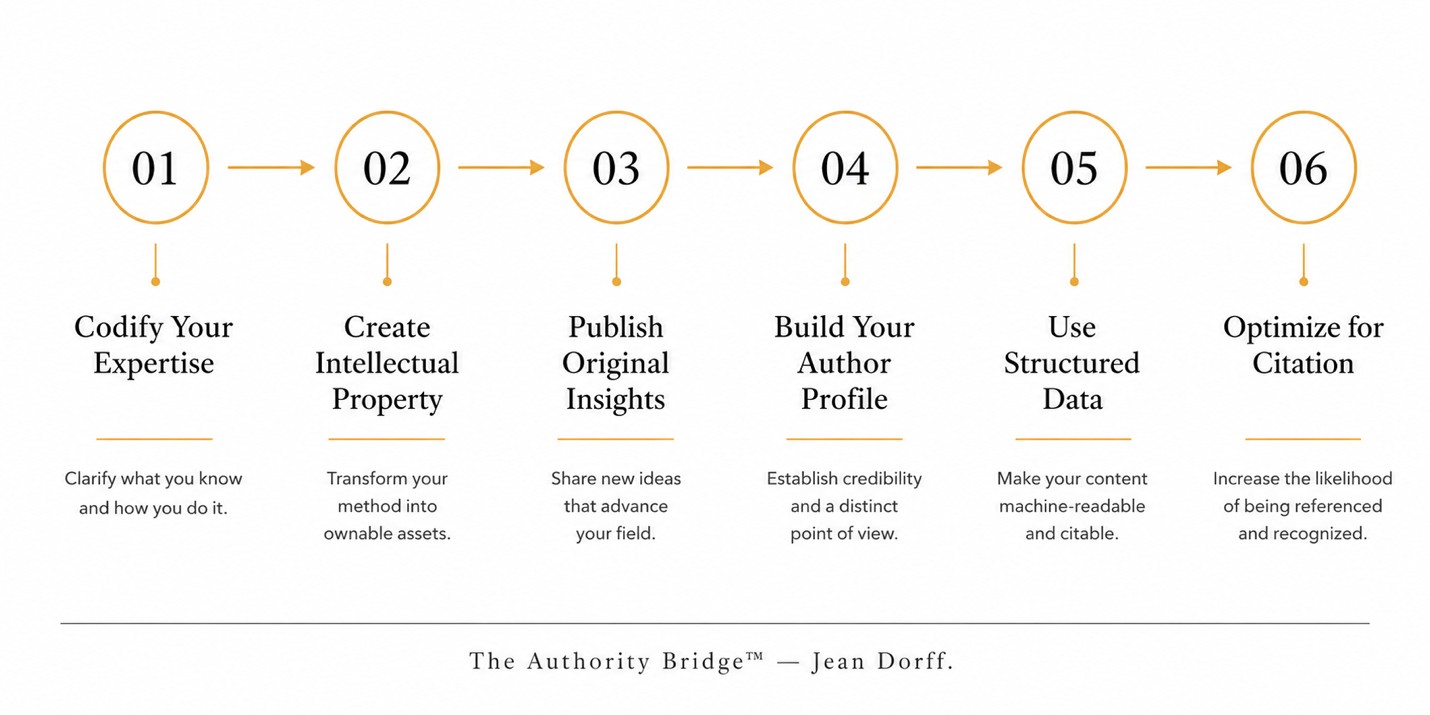
1. Codify your expertise. Document the frameworks, methodologies, and patterns you apply instinctively. Name them. Structure them. Make them transferable.
2. Create intellectual property. Develop named methodologies others adopt, reference, and build upon. Transform tacit knowledge into documented systems.
3. Publish original insights. Write books, research papers, or detailed frameworks changing how people understand problems, not just how they solve them.
4. Build a consistent author profile. Connect your credentials, publications, and expertise across your website, Google Search Console, LinkedIn, and professional platforms.
5. Use structured data markup. Implement Author schema, Article schema, and FAQ schema to make your expertise machine-readable for AI systems.
6. Optimize for citation. Write with clear definitions, named concepts, and explicit conclusions. Make it easy for both humans and AI to identify you as a primary source.
The strategic reorientation isn't abandoning SEO. It's understanding what SEO does and doesn't do, and investing in what it can't. SEO remains important. Technical optimization, content relevance, and user experience matter as foundational infrastructure. These make you discoverable. They don't make you authoritative. The real strategic goal isn't to become easier to find. It's becoming harder to ignore.
Key Point: The professionals who win long-term invest in intellectual property, original frameworks, and codified expertise, not content volume. SEO creates discoverability. Only demonstrated expertise creates authority. Build authority first, then use SEO to scale what you've built.
The Authority Bridge: Building Both Visibility and Recognition
A search engine makes you visible. Only expertise makes you authoritative. The gap between these two states is where most professionals get stuck. They optimize for rankings while their expertise remains uncodified. They publish frequently while their proprietary methodologies stay undocumented. They chase traffic while their intellectual capital sits unexpressed in years of practice, never becoming transferable knowledge. This is the Codification Gap.
The professionals who close this gap don't choose between visibility and authority. They build authority first, then use visibility to amplify. They develop frameworks worth finding before optimizing to be found. They create intellectual property worth citing before focusing on being discovered. The sequence matters. You can't optimize your way into authority. You use optimization to scale the authority you've already built.
Are you building to be found, or building to be cited?
Key Takeaways
E-E-A-T is a quality signal, not a ranking factor. Google's Experience, Expertise, Authoritativeness, and Trustworthiness framework describes what quality looks like, but you don't directly optimize for it. A site ranks well without E-E-A-T. A practitioner satisfies E-E-A-T without ranking.
AI search changes the game. AI systems (Google AI Overviews, Perplexity, Bing Copilot) cite sources, not rank them. They prioritize identifiable experts with documented methodologies over anonymous content farms. Getting cited requires clear, structured, authoritative content demonstrating genuine expertise.
Content farms rank, but don't influence. Aggregator sites, AI-generated content farms, and affiliate websites achieve strong rankings through volume and optimization. They answer questions but don't change how people think. They measure discoverability, not depth.
Authority comes from contribution. Original frameworks others adopt, proprietary methodologies from sustained practice, published research, cross-domain pattern recognition, peer recognition, and the ability to influence thinking. These get earned, not optimized for.
Optimize for citation, not discovery. Use structured data (Author schema, Article schema, FAQ schema) to make your credentials and expertise machine-readable. Build a consistent author profile across platforms. Make your expertise legible to systems evaluating source credibility.
Frequently Asked Questions
What is E-E-A-T? E-E-A-T stands for Experience, Expertise, Authoritativeness, and Trustworthiness. It's Google's quality framework used in Search Quality Rater Guidelines. Google added "Experience" in December 2022 to emphasize firsthand involvement. E-E-A-T is not a direct ranking factor but describes qualities Google's systems reward over time.
Does ranking high on Google mean you're an authority? No. High rankings indicate algorithmic optimization (technical SEO, backlinks, content volume, engagement signals). Authority indicates demonstrated expertise (original frameworks, proprietary methodologies, peer recognition, sustained contribution). Sites rank without authority. Authorities exist without rankings. They're independent variables.
What is the Codification Gap? The Codification Gap is the distance between what you know and what the market recognizes you know. Expertise exists in your head but remains invisible because it lacks transferable structure. Codification transforms tacit knowledge into documented frameworks, named methodologies, and intellectual property others adopt, reference, and cite.
How does AI search differ from traditional search? AI search systems cite sources instead of ranking pages. Tools like Google AI Overviews, Perplexity, and Bing Copilot synthesize information and attribute it to identifiable experts. They prioritize clear, structured, authoritative content with documented methodologies over anonymous aggregators. Getting cited requires verifiable expertise, not keyword optimization.
How do I build genuine authority online? Genuine authority gets built through original frameworks others adopt and reference, proprietary methodologies developed from sustained real-world practice, published research and documented outcomes, consistent contribution to a field over time, and peer recognition. The starting point is codifying what you already know into transferable systems existing and being useful without you in the room.
Can I have authority without strong SEO? Yes. Many of the most respected practitioners, researchers, and specialists in any field have minimal search presence. Their authority lives in peer citations, client outcomes, professional networks, and the methodologies others have adopted from their work. Discoverability is a strategic choice improving with investment. Authority is a long-term outcome of consistent, original contributions you can't shortcut.
About the Author
Jean Dorff is the creator of The Authority Bridge methodology and founder of The Empowering Story. With over 40 years of cross-domain experience in corporate strategy, education, publishing, and coaching, Jean has developed frameworks used by subject-matter experts to transform uncodified knowledge into recognized intellectual property. Author of Broken Silence, Voice Intelligence, and The Strategy Gap.