
The hidden cost of uncodified expertise is draining professionals of revenue, positioning power, and market visibility. Learn why codifying your expertise is no longer optional in an AI-driven economy — and how structured knowledge documentation transforms professional services pricing, discoverability, and long-term value.

You are paying a cost you don't know exists.
What is uncodified expertise? Uncodified expertise refers to specialized knowledge and skills that remain undocumented, unstructured, and unarticulated in a formal framework. When professionals fail to systematically organize and communicate their expertise, the market struggles to accurately perceive, evaluate, and compensate their true value.
Every day that your expertise remains uncodified, there is a cost being drawn against it. Not on a balance sheet. Not in your quarterly reports. In missed opportunities, misread value, and market mispositioning.
The market doesn't wait for you to articulate what you know. It moves forward anyway, filling the gaps with assumptions. And those assumptions are rarely generous.
Key Takeaways: The Hidden Cost of Uncodified Expertise
Uncodified expertise creates a market perception gap that forces professionals to compete on price rather than value.
Five hidden costs compound over time: positioning, conversion, referral, AI visibility, and time inefficiency.
AI-driven search is accelerating the visibility crisis — systems are recommending expertise they can parse and reference, not expertise that exists only in private conversations.
Codification creates measurable ROI: higher fees, faster sales cycles, accurate referrals, and AI discoverability.
The longer you wait, the more you pay — each year of delay compounds the cumulative financial and opportunity cost.
The Market Doesn't Pause for Clarity
When expertise lacks structure, buyers default to the only metric they can easily compare: price.
Professional services offerings are inherently unique, yet the value remains subjective and difficult to quantify. Determining price based on perceived value alone creates a fundamental market problem. The value aspect varies from client to client, and without codification, the market has no framework to evaluate what you actually bring.
This isn't a branding problem. It's a structural one.
Knowledge work produces intangible results that are challenging to measure. Simple quantitative metrics fail to capture the true value of knowledge work, where quality matters more than quantity. When the market can't see differentiated value, it can't pay for it.
So it defaults. To assumptions. To comparisons. To the lowest common denominator.
Five Hidden Costs of Uncodified Expertise
Here's what uncodified expertise costs you, line by line:
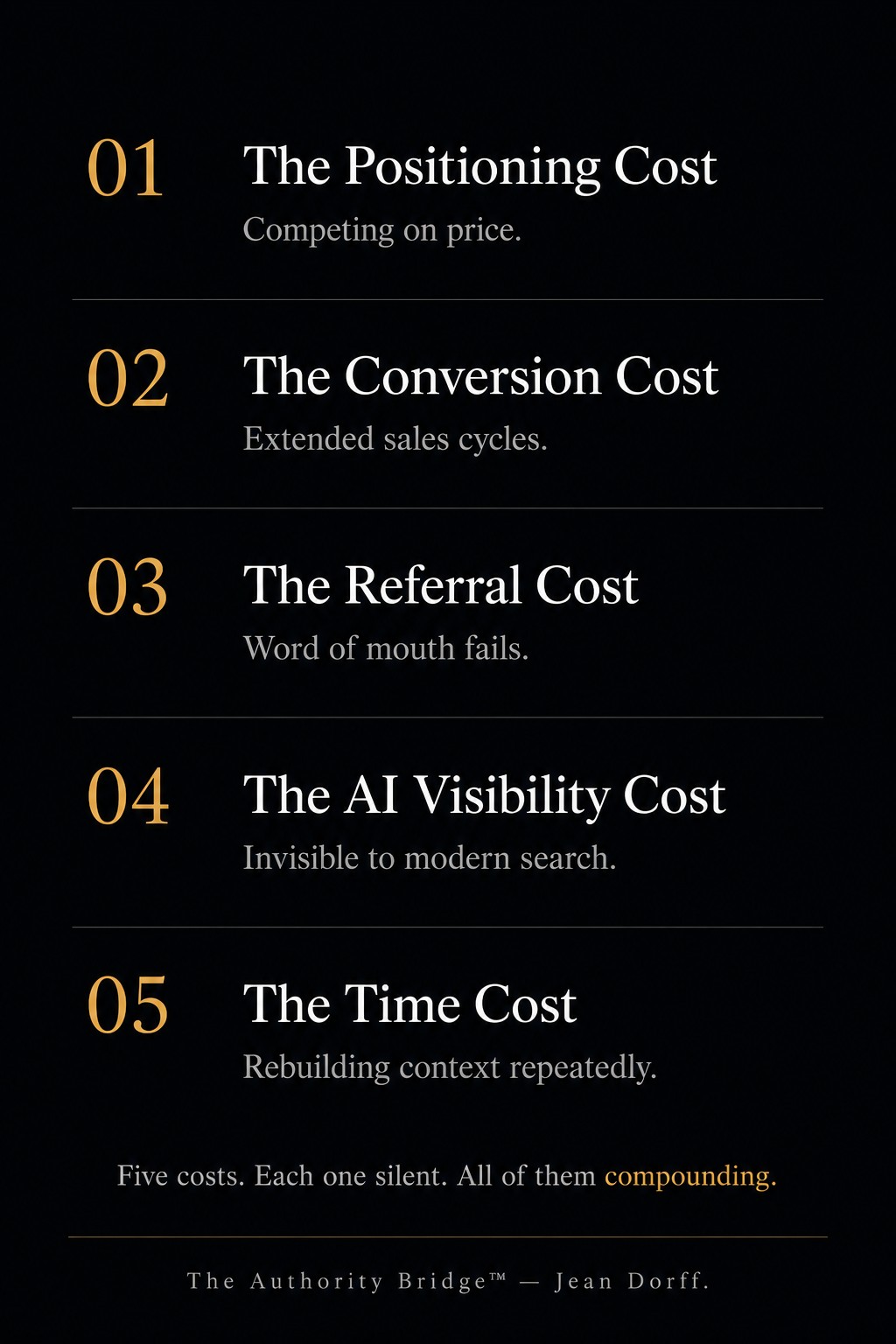
1. The Positioning Cost: Competing on Price Instead of Expertise
You compete on price because your value isn't legible to the market.
Without structure, buyers can't distinguish between you and someone with half your experience. They see two consultants, two coaches, two strategists. They pick the cheaper one.
One of the cruel ironies of time-based billing is that it punishes fast professionals. The more refined your expertise, the faster you work. The faster you work, the less you can charge by the hour. Your efficiency becomes a penalty.
From the client's perspective, what you know has greater value than your workflow or how many hours you spend working. But if they can't see that knowledge structured and articulated, they default to evaluating your time instead.
2. The Conversion Cost: Extended Sales Cycles for Professional Services
Your sales cycles stretch because buyers can't self-qualify.
Every discovery call becomes an education session. Every proposal requires extensive context-building. Every conversation starts from zero because there's no shared reference point.
You spend hours explaining what you do, how you do it, and why it matters. Not because buyers are difficult, but because you haven't given them the structure to understand it on their own.
The conversion cost compounds. Each extra week in the sales cycle is revenue delayed. Each additional call is time you can't spend delivering value to existing clients.
3. The Referral Cost: Ineffective Word-of-Mouth Marketing
Word of mouth doesn't travel accurately when expertise lacks structure.
Someone loves your work and wants to refer you. They say, "You should talk to Sarah, she's great." But they can't articulate what makes you great, what problems you solve, or who you're best suited to help.
The referral arrives vague. The prospect comes in with misaligned expectations. You spend the first conversation realigning rather than exploring fit.
Referrals should be your most efficient channel. Instead, they require the same heavy lifting as cold outreach.
4. The AI Visibility Cost: Disappearing from Modern Search
This one is already here, and it's accelerating.
The systems deciding who gets found aren't waiting for you to show up with structure. They're recommending someone else.
AI doesn't search your site the way a human does. It looks for structure. Patterns. Frameworks it can parse and reference. If your expertise exists only in prose, stories, and untagged case studies, the AI moves past you.
This isn't theoretical. It's happening now. Someone is asking an AI system for a recommendation in your domain today. If your work isn't structured, you're not even in the room.
5. The Time Cost: Rebuilding Context Repeatedly
You rebuild context from scratch in every conversation.
Every new client. Every speaking opportunity. Every partnership discussion. You start at the beginning, explaining your methodology, your approach, your framework.
There's no shared language. No reference point. No existing structure the other person can grab onto.
The time cost is the most insidious because it feels normal. You think this is just how professional services work. It's not. It's what happens when expertise remains uncodified.
The Compounding Cost of Delayed Knowledge Codification
Here's the part that hurts.
If you're five years into your career, you've been paying this cost for five years. Ten years in? A decade of compounding costs. Twenty years? The cumulative drain is staggering.
Every underpriced engagement. Every referral that went to someone less qualified because your value couldn't be articulated. Every pitch that required you to rebuild context from scratch. Every prospect who chose someone cheaper because they couldn't see what made you different.
The hidden cost doesn't just affect your current revenue. It affects every opportunity you didn't see, every client who couldn't find you, every referral that landed with the wrong person because the right person couldn't articulate your value.
The longer expertise remains uncodified, the more the market has filled that void with its own narrative. And you've been living inside that narrative, wondering why positioning feels so hard.
How Codifying Expertise Reduces Professional Services Costs
Codification isn't a content strategy. It's not a rebranding exercise.
It's a structural intervention that changes how the market reads, prices, and references your work.
When you codify expertise, you create legibility. The market no longer has to guess what you do or how you do it. Buyers can self-qualify before they ever talk to you. Referrals arrive with accurate context. AI systems have structured data to reference and recommend.
This is knowledge management at the strategic level — not just organizing information, but structuring your intellectual capital in ways that increase market value, improve consultant positioning, and enable premium pricing strategies.
Codification makes the invisible visible.
It transforms expertise from something you have to explain in every interaction into something the market can recognize, evaluate, and pay for appropriately.
Measurable Benefits of Codified Expertise
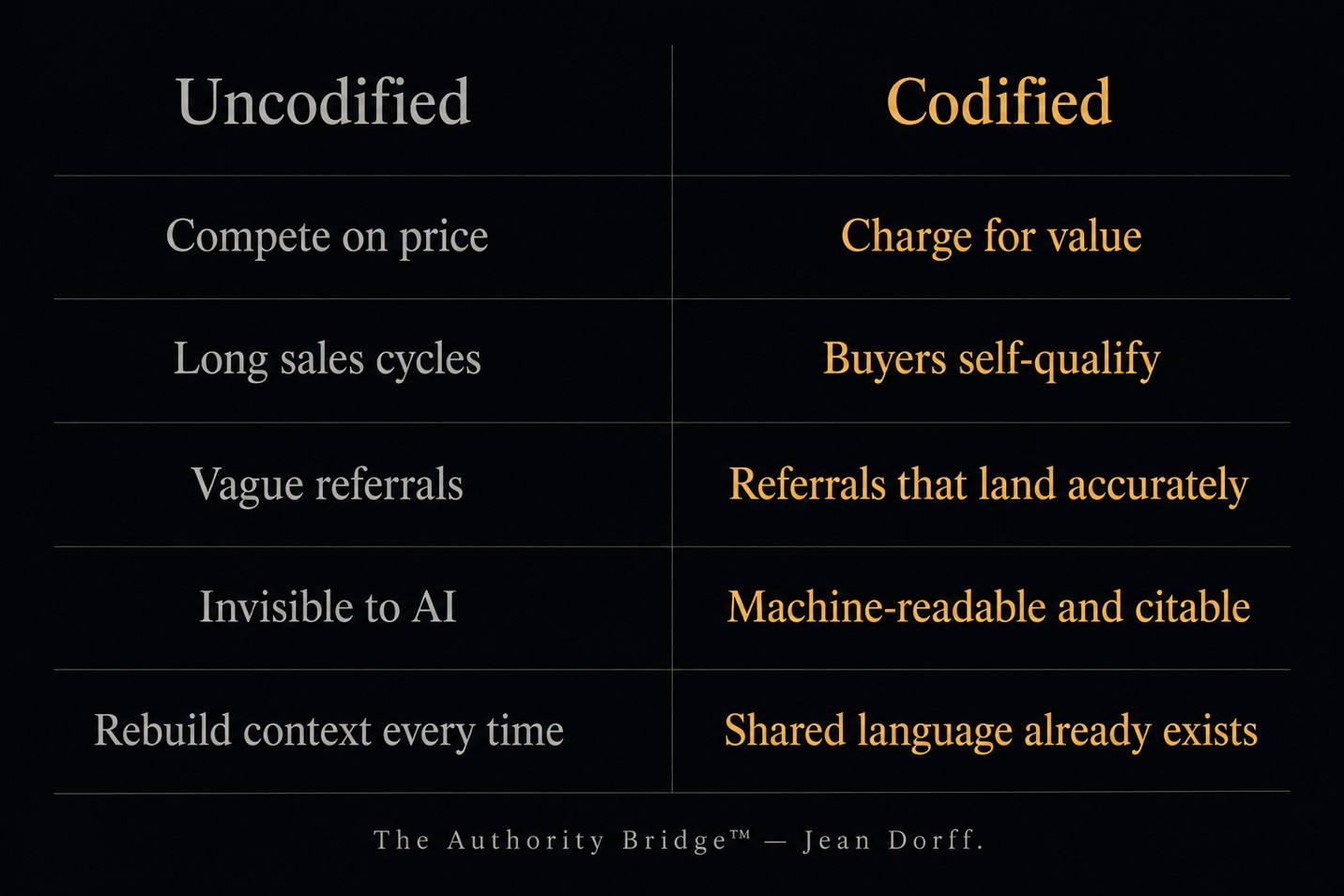
The outcomes are concrete.
Higher fees. When value is legible, you can charge for what you know, not just what you do. Clients understand they're paying for refined expertise, not hourly effort.
Faster conversions. Sales cycles compress because buyers arrive pre-qualified. They've already determined fit through your structured content. Discovery calls become confirmation conversations, not education sessions.
Accurate referrals. People can explain what you do and who you help. Referrals land with the right context, reducing friction and increasing close rates.
AI discoverability. Your expertise becomes machine-readable. When someone asks an AI system for a recommendation in your domain, you're in the consideration set. When you're not structured, you're not even in the room.
Time reclaimed. You stop rebuilding context in every conversation. Shared language and reference points already exist. You can move directly to the work that matters.
The hidden cost has been running in the background of your career. You've paid it in missed opportunities, underpriced work, and endless re-explanation.
Codification is how you stop paying it.
The market is moving forward with or without your clarity. The question is whether you're going to let it continue writing your narrative, or whether you're going to structure your expertise in a way that the market can finally see, understand, and value appropriately.
The cost is optional. You just didn't know you had a choice. Now you do.
FAQs: Codifying Expertise and Knowledge Documentation
What does it mean to codify expertise? Codifying expertise means systematically documenting, structuring, and articulating your specialized knowledge into a formal framework. This includes creating repeatable methodologies, defining your unique processes, and organizing your intellectual property so the market can understand and evaluate your value without requiring constant explanation.
How much does uncodified expertise actually cost professionals? The financial impact compounds across five areas: positioning costs (competing on price instead of value), conversion costs (extended sales cycles), referral costs (misaligned leads), AI visibility costs (zero discoverability in AI-mediated search), and time costs (rebuilding context repeatedly). Over a 10-year career, these hidden costs can represent hundreds of thousands in lost revenue and missed opportunities.
Why is structured data important for AI search visibility? AI systems deciding who to recommend don't read your website the way a human would. They look for structure, not stories. If your expertise lives only in case studies and untagged blog posts, the system can't parse it. And if it can't parse it, it can't recommend it. You become invisible by default — not because your work isn't strong, but because it isn't structured.
What are the immediate benefits of codifying professional expertise? Professionals who codify their expertise typically experience higher fees (charging for knowledge rather than time), faster sales cycles (buyers self-qualify through structured content), more accurate referrals (clear articulation of value), improved AI discoverability (machine-readable expertise), and significant time savings (reduced need to rebuild context in every conversation).
Conclusion
The hidden cost has been running quietly in the background of your career. You've paid it in underpriced work, misaligned clients, referrals that didn't land, and conversations that started from zero every single time.
It wasn't a talent problem. It wasn't a marketing problem. It was a codification problem.
The market was always willing to recognize your expertise. It just needed something to recognize it from.
About the Author
Jean Dorff is the creator of The Authority Bridge, a methodology for translating deep expertise into recognized intellectual property. With four decades of cross-domain experience spanning corporate strategy, education, publishing, and coaching, Jean has worked alongside subject matter experts, consultants, and practitioners who possess extraordinary knowledge that the market consistently undervalues. His work centers on a single observation: the gap between what professionals know and what the world recognizes they know is not a talent problem — it is a codification problem. He works with those who are ready to close that gap.