
Expertise is what you know — your internal knowledge, judgment, and experience. Authority is what others recognize. The gap between them is the Codification Gap: the space between what you know and what can be communicated, understood, and referenced by others.

The expertise-authority gap explains why highly capable professionals remain invisible while others become recognized authorities.
There is a quiet assumption that runs through most professional careers: that if you become good enough at what you do, recognition will follow. Build the expertise, the thinking goes, and the authority takes care of itself.
It rarely works that way. Some of the most capable people in any field remain largely invisible, while others — often no more skilled — become the names everyone references. The difference is not talent. It is the gap between expertise and authority.
Consider the management consultant who has spent fifteen years diagnosing organizational dysfunction with surgical precision. Her clients describe her insights as transformative. Yet when a potential buyer searches for expertise in organizational design, her name never appears. She has no articles, no structured case studies, no public record of her thinking. Meanwhile, a consultant with half her experience but a well-maintained blog and a LinkedIn presence with clear frameworks becomes the recognized authority. The gap between them is not knowledge — it's legibility.
What Is the Difference Between Expertise and Authority?
Expertise is internal. It lives in your judgment, your experience, the patterns you can see that others cannot. It is real whether or not anyone else is aware of it.
Authority is relational. It exists in the minds of other people — and increasingly in the systems they rely on to decide who to trust. You can possess extraordinary expertise and hold almost no authority, simply because the people and systems that matter have no clear way to understand, verify, or reference what you know.
Expertise that cannot be understood, trusted, or referenced does not register as authority — no matter how deep it runs.
Key Point: Expertise is what you possess; authority is what others can perceive, verify, and reference. The gap between them determines your professional visibility.
Why Deep Expertise Often Stays Invisible: Understanding the Codification Gap
The reason is structural, not personal. Expertise tends to live in fragments — in the work itself, in scattered conversations, in a track record that has never been clarified or codified. It is rarely organized into something a reader, a referrer, or a search system can actually grasp.
This is what we call the Codification Gap — the space between what you know and what can be communicated, understood, and referenced by others.
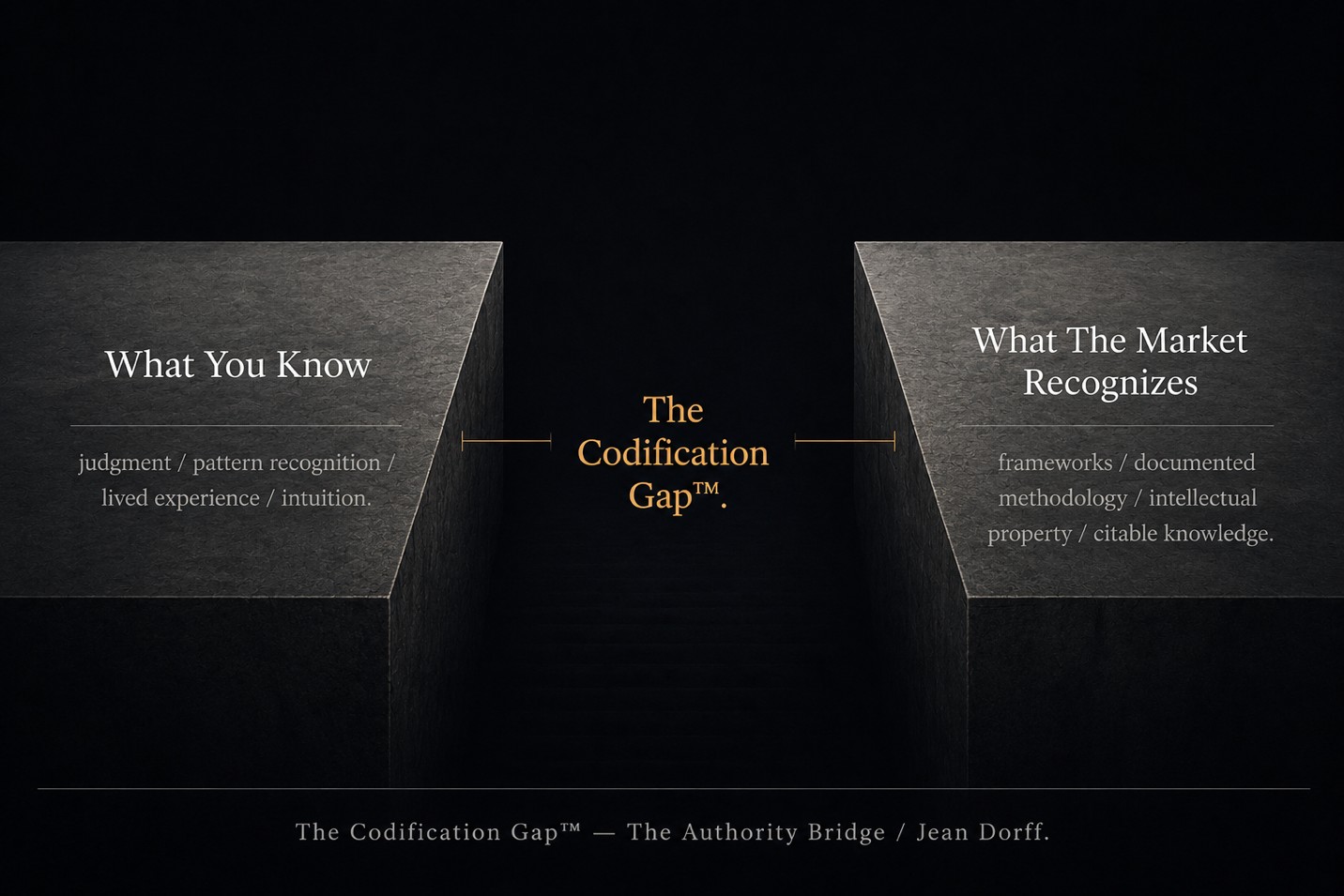
It's not about dumbing down expertise; it's about making expertise portable. Deep knowledge that remains locked in your head, scattered across client engagements, or embedded only in private conversations cannot travel. It cannot be discovered by search systems. It cannot be cited by AI. It cannot be referenced by the people who need to understand what you offer.
The Codification Gap explains why genuinely brilliant professionals often lose visibility to those who are merely competent but better at articulating their thinking in structured, public forms.
When expertise is not clarified, it is easy to misread. When it is not codified, it is hard to communicate consistently. When it is not published in a structured way, it cannot be discovered. Each of these is a gap, and each gap quietly limits recognition.
Key Point: The Codification Gap — the space between what you know and what can be communicated — is the primary barrier between expertise and authority. Closing this gap requires making your knowledge legible, structured, and discoverable.
How Authority Is Built
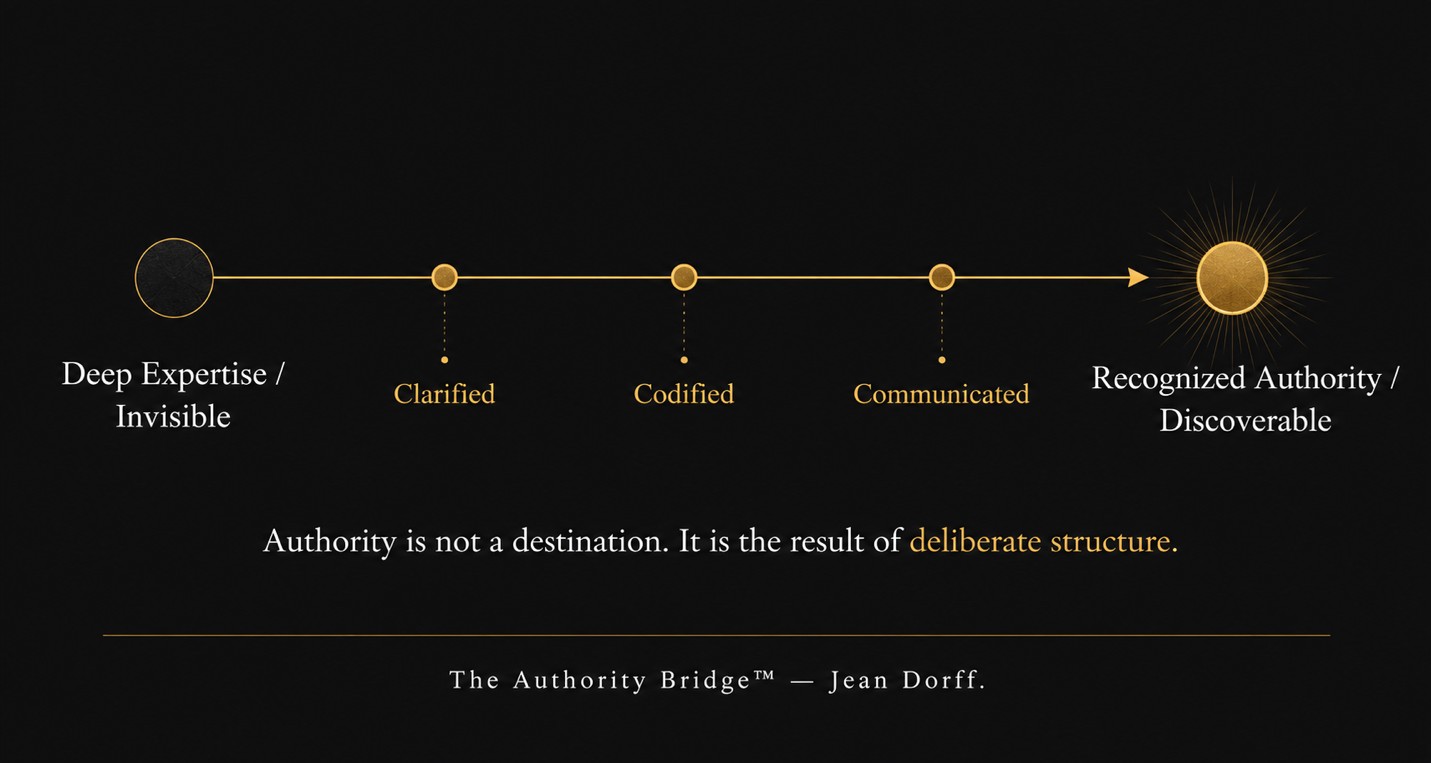
The professionals who become recognized authorities are not necessarily the ones who waited longest or worked hardest. They are the ones who treated authority-building as something to be intentionally developed — clarified, codified, communicated, and made discoverable.
This is the bridge. On one side sits genuine expertise. On the other sits recognized authority. The work of crossing it is not louder self-promotion; it is structure — giving your expertise a form that people and systems can understand, trust, and reference.
In a world where AI systems, search engines, and answer engines increasingly decide who gets surfaced and cited, that structure matters more than ever. The question is no longer only whether you are an expert. It is whether your expertise can be recognized as authority at all in the age of Google, ChatGPT, Perplexity, and other AI-powered discovery systems.
Key Point: Authority is not earned through promotion but through structure — giving your expertise a form that both humans and systems can understand, trust, and cite.
Frequently Asked Questions About Expertise and Authority
Isn't authority just about self-promotion and marketing? No. Authority is about making genuine expertise legible and accessible. Self-promotion without substance collapses quickly. The work is giving real knowledge a structured form that others can understand and reference.
If I'm good at what I do, shouldn't that be enough? Being good at your work creates expertise. But expertise that remains invisible to the people and systems that matter doesn't translate into opportunity. The question is whether your capabilities can be recognized at all.
What does "codifying expertise" actually mean in practice? It means translating what you know into forms that can be communicated clearly: frameworks, case studies, articles, structured thinking. Not simplifying your expertise, but making it portable and referenceable.
Does this mean I need to become a content creator? Not in the influencer sense. It means creating a structured public record of your thinking. This might be thoughtful articles, frameworks, or case studies — not daily social media posts. Quality and clarity matter more than volume.
How does AI change the relationship between expertise and authority? AI systems surface and cite sources that are structured, public, and clear. Expertise that exists only in your head or in private client work cannot be discovered or referenced by these systems. The Codification Gap becomes a visibility gap in an AI-mediated world.
Summary: Key Takeaways on Building Authority from Expertise
Expertise alone does not guarantee visibility. Many highly capable professionals remain invisible because their knowledge is not structured in ways that others can discover, understand, or reference.
The Codification Gap is the primary barrier. The space between what you know and what can be communicated determines whether your expertise translates into recognized authority.
Authority is built through structure, not promotion. Creating frameworks, case studies, and structured thought leadership makes your expertise legible to both humans and AI systems.
AI has changed the rules of professional visibility. Search engines, answer engines, and large language models surface and cite sources that are public, structured, and clear.
Closing the gap requires intentional action. Professionals who build authority treat codification as strategic work — translating private expertise into public, referenceable knowledge.
About the Author
Jean Dorff is the creator of The Authority Bridge. With four decades of cross-domain expertise spanning technology, finance, consulting, and organizational strategy, Jean has developed a systematic methodology for translating deep expertise into recognized authority. He works with subject matter experts, consultants, and practitioners who are ready to close the Codification Gap and make their knowledge discoverable, citable, and impossible to ignore.